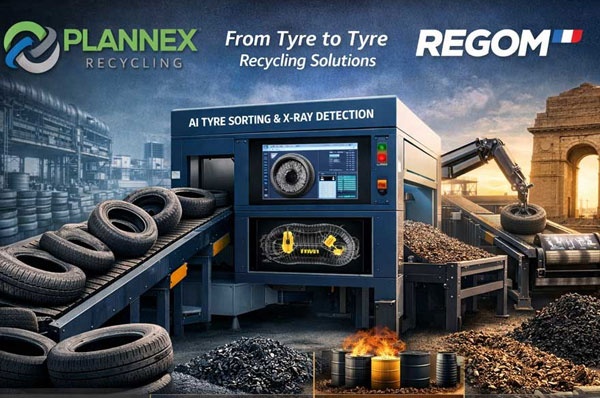
Plannex Recycling, India’s pioneering recycling and waste management companies, has partnered with REGOM, a France-based company that develops AI-powered machines and software to extend tyre life and improve tyre identification. Together, the two companies are working towards a shared vision: building a “From Tyre to Tyre” closed-loop recycling model in India, which will keep end-of-life tyres in productive use for as long as possible.

The partnership comes at a time when India’s tyre recycling sector is under immense pressure, with labour shortages making manual sorting harder to sustain. Additionally, manual sorting is inherently inconsistent and limits the quality of output streams. Hidden contaminants such as batteries, TPMS sensors, metal rim fragments, and other embedded components damage shredders, causing unplanned shutdowns and creating fire hazards on the plant floor. The lack of digital traceability also leaves recyclers exposed to EPR compliance risks, including concerns about inaccurate or unverifiable credit claims.

New Delhi, Mar 3 (PTI) Recycling and waste management firm Plannex Recycling on Tuesday said it has partnered with France’s REGOM to build a closed-loop tyre recycling ecosystem in India.

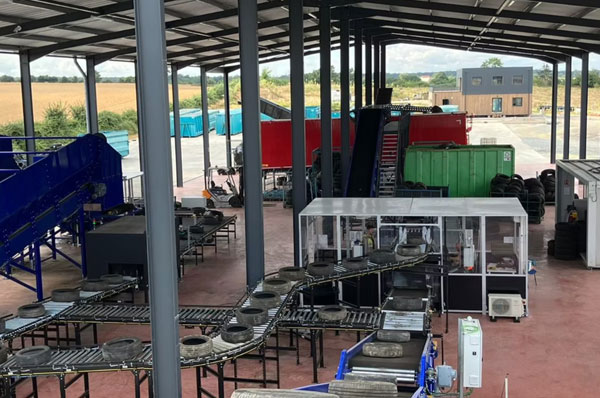
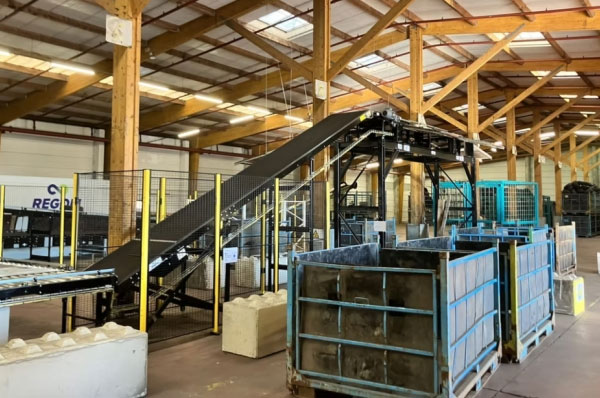
Under the partnership Plannex will deploy REGOM’s automated AI-based tyre sorting and identification systems, covering both light vehicles (LV) and truck and bus tyres (TT), the company said in a statement.

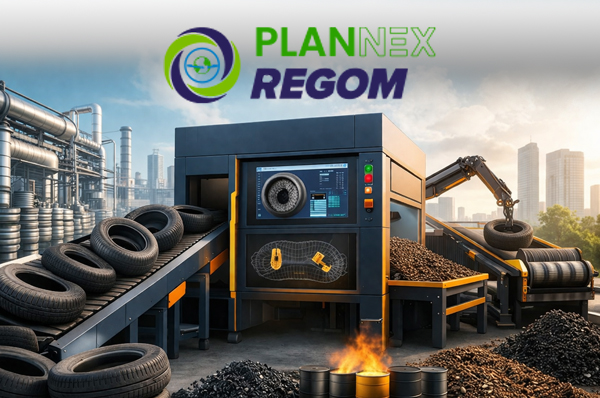
Plannex Recycling has entered into a strategic partnership with French technology firm REGOM to establish a closed-loop tyre recycling system in India. The collaboration aims to replace manual sorting with AI-powered identification and X-ray technology to improve traceability and processing safety.

The initiative addresses operational challenges in the Indian recycling sector, including labour shortages and equipment damage caused by hidden contaminants such as batteries and TPMS sensors. By automating the identification process, the companies intend to create a verifiable data trail for Extended Producer Responsibility (EPR) compliance.

Plannex Recycling has partnered with Regom to deploy artificial intelligence-based tyre sorting and identification systems in India, as the companies look to build a closed-loop “tyre-to-tyre” recycling model.

The partnership comes at a time when India’s tyre recycling sector is facing operational challenges, including labour shortages and inefficiencies in manual sorting. According to the companies, manual sorting often leads to inconsistent output quality and fails to detect embedded contaminants that can damage recycling equipment.

Plannex Recycling, one of India’s leading recycling and waste management companies, has entered into a strategic partnership with REGOM, a France-based tyre solutions specialist known for its AI-powered machines and software designed to extend tyre lifespan and enhance tyre identification.

Through this collaboration, the two companies aim to establish a “From Tyre to Tyre” closed-loop recycling ecosystem in India, ensuring end-of-life tyres are kept in productive circulation for as long as possible. The initiative seeks to combine advanced technology with structured recycling processes to drive efficiency, transparency, and sustainability across the tyre value chain.

Plannex Recycling has teamed with Regom to deploy artificial intelligence-based tyre sorting and identification technologies in India, as the firms seek to establish a closed-loop “tyre-to-tyre” recycling model.

The collaboration comes at a time when India’s tyre recycling sector is suffering operational issues, such as labor shortages and inefficiencies in manual sorting. According to the companies, manual sorting frequently produces variable output quality and fails to discover embedded impurities that can harm recycling equipment.

AI-Powered Automation to Replace Manual Sorting

Plannex will use Regom’s automated, AI-powered sorting and identification technology for light-vehicle tyres as well as truck and bus tyres. The system uses AI vision technology to categorize tires based on their type, condition, and possible reuse applications.

India has seen a steady buildup of policy around waste and recycling over the last few years. Rules have tightened. Compliance has expanded. Targets are clearer. The intent is visible across plastics, wastewater, organics, and municipal solid waste.

The strain shows up later in the chain.

Sorting facilities remain limited. Processing plants are unevenly distributed. Advanced recycling capacity is concentrated in a few pockets. When waste moves beyond collection, systems start to thin out. This is where delays begin and economics weaken.

As a result, many initiatives struggle to move beyond pilot scale. Private capital steps in only when feedstock, land access, and operating timelines are clearly defined. That clarity rarely exists without structured collaboration between public authorities and private operators.
This is why public private partnerships matter. Not in principle. In execution.

As India’s entrepreneurial ecosystem comes of age, women founders are reshaping what success truly means. Growth today is no longer measured by scale alone, but by purpose, resilience, and long-term impact. Across sectors from sustainability to spiritual technology, women entrepreneurs are building businesses that balance innovation with empathy, and ambition with responsibility.

For Ishita Bansal, Co-Founder and COO, Plannex Recycling, the foundations of entrepreneurship were laid early. Growing up in a business-oriented family meant she was exposed to conversations around markets, opportunity, and leadership from a young age. “Those early discussions shaped my entrepreneurial outlook,” she shares, adding that her father’s leadership journey played a significant role in inspiring her path.

In this edition of Recap’25, StartupTalky speaks with Yashraj Bhardwaj, Co-Founder and CSO of Plannex Recycling, who reflects on India’s rapidly evolving waste management ecosystem and the urgent need to move beyond fragmented, manual recycling systems toward scalable, technology-led circular solutions. Drawing from his experience building Plannex, Bhardwaj highlights how inefficiencies in reverse logistics and lack of transparency have historically limited India’s recycling potential—and why operational excellence is just as critical as sustainability intent.

He goes on to discuss how Plannex Recycling is addressing these challenges through its proprietary waste ERP platform, AI-powered sorting, and GPS-tracked collection systems, enabling precision, compliance, and measurable impact across multiple waste streams. The conversation also explores the growing role of EPR mandates, the shift toward integrated waste management models, and Plannex’s roadmap for expanding its collection network, recycling capacity, and global footprint—while staying anchored to its vision of a zero-waste, circular economy.